
The Hatch

In the unforgiving light of a collector’s bathroom, I noticed a cyst rising from my cheek. Parting my hair to the other side, I blotted the shine from my face and exited to an embarrassingly long line forming in the hallway. A duo in matching ballerina Tabis rushed in after me with mercenary resolve. A faint draft of their combined scents lingered pleasantly in their wake. Half of the party smelled like an Aesop store and I began to wonder if there were any downsides to everyone smelling like the same handful of trademarked scents.
I thought back ten years ago to a guy I met in New York who insisted on the “importance of leaving one’s ‘wetware’ untampered” by chemical perfumes. He told me about a study where participants were trained to track the scent of a chocolate bar across a football field with their noses to the ground like truffle pigs.
“People need to return to their olfactory baseline. Humans can be trained to do this work, but no one wants to be on their hands and knees doing these kinds of exercises,” he said taking a deep theatrical inhale through his nose and closing his eyes. “But imagine an alternate historical timeline where artificial scents were viewed no differently than blindfolds.”
It felt borderline phrenological, but tonight I entertained the thought: What if he was right? What if we were unwittingly destroying some vital piece of our intuition? Could danger be smelled? Could benevolence? Could egoism? What could I have smelled on Eva?
After everything, I still didn’t know how to feel about her. When she first scouted me, she said I had a “regal air” and suggested curtain bangs like Jane Birkin.
“This is you. You have to do it,” she’d said, squinting and framing little fake bangs across my forehead with her fingers. The gentle click of her stacked rings soothed me as she admired me in the mirrored wall behind the bar. “It’s all about having—or at least faking—facial balance.” Broad-shouldered and androgynous, I once was told at a casting that, “you can be ugly and still have the look.” Eva scrawled in all caps across her business card before handing it to me: BANGS, BANGS, BANGS! I cleared my throat reflexively as if to dislodge the memory like a tonsil stone.
“They killed it on the details, didn’t they? Is that a dog?” A soft-spoken man in head-to-toe raw denim gestured towards the bathroom door handle. I reached out to touch its curled metal tongue. The latch felt cool like a trigger.
“There’s another bathroom by Percy’s office,” chimed the host from the kitchen. The tail of the bathroom line began to scatter. Backlit and clicking towards us on delicate kitten heels, she reached behind me and bumped the dimmer.
“That’s so much better than standing in a dark little cave, right?” She stood there momentarily admiring her row of guests, her asymmetric dress strapping her tiny frame like a wrist in a splint.
“You like them?” She motioned to the handle. “These were actually auctioned on the cheap out of Phil Spector’s Alhambra place,” she said, lowering her voice. I withdrew my hand from the metal creature’s mouth. “Italian. Seventeenth century, I think.” A coarse laugh from outside knifed the sudden silence between songs. “They were supposed to be for the master bedroom, but Percy said we should move them down here for energetic reasons.” Everyone nodded in solemn agreement and I excused myself. Angling through the wall of bodies, the living room, I’d decided, was losing air.
Outside, the night was warm and starless. I returned to the lanterned pergola by the pool where Marlie and Oscar—the artists whom I’d met earlier in the night—sat chain smoking. Marlie, a silver-blonde with a South African accent beckoned for me to sit on the edge of her chaise. Oscar had self-described as a “sculptor of the immaterial” and refused to elaborate. Sitting cross-legged on the ground, he drunkenly carved faces into the poolside sandstone with a pebble.
“Marlie, at these things you have to train your brain to say, ‘So, good to see you’ instead of ‘So nice to meet you.’ Trust me on this.” Oscar glanced up at me and offered me the other half of his orange wine.
“Did you see that Eva-what’s-her-name was here earlier? Did you guys see her? The woman from–fuck–Eva Something. Wait, don’t tell me,” Marlie pressed her fist between her eyes. “Fuck! I know this!”
“Eva Gallo, yeah. I saw that. Why did I think she, like, went to jail or something?” Oscar leaned back on his hands and tilted his head up at the trellis, his face a gnarled grid of moonlight and shadow.
“I mean, I think we all definitely thought she was going to go to jail in 2015-ish,” Marlie ashed her cigarette and cocked her head to look at me, her face awash in the green light of the pool. “I never have a good gauge of these things. Was the Eva Gallo thing big news abroad too or just here?”
“No, I didn't hear about it,” I lied, stroking the soft black fringe cascading from Marlie’s purse. My cheeks burned. I felt grateful to be in the dark while they explained Eva Gallo’s project to me.
It was funny hearing about it from someone else’s perspective. I'd obsessively watched all of Eva’s interviews on YouTube, perhaps as some consolation for never being able to talk about the project myself.
“The conspiracies that emerge after The Hatch were and are as much a part of the performance as the show itself–maybe more so even,” Eva had said in a recorded lecture at UCLA, her green eyes glinting through her signature thick-rimmed glasses. In all of her interviews, she appeared in something beige and linen, like some kind of ascetic atoning for the art world’s extravagance.
The execution of the project had been flawless. Nearly everything unfolded as planned. The memory of it stayed clear in my mind, how it felt to wait in the wings, the music humming so loud it filled my chest and vibrated the stage underfoot. Stepping out onto the catwalk, the lights dissolved the crowd into a faceless black haze. The floor beneath me opened up on cue with the music. And the delicious precision of the drop: suddenly airborne in the darkness, I felt invincible, like a witch vanishing on the gallows.
“Insofar as our remaining mediums are the scraps of dead and cannibalized styles, we figured that art should change or die. This project, this enormous undertaking, all of it would not have been possible without the commitment of the many dedicated individuals pledging their lives for this idea. Because for the styles of the dead to rest, we must call upon the living.” Eva repeated variations of this line across a staggered trail of media appearances. She said it first in Spike, then Artforum. And then again, several months later, she said it in her interview with The New York Times Magazine. And again she repeated these words, though more stumblingly this time, at the premiere of her eponymous documentary screened that same year at Cannes. Each interview felt as though she was speaking directly to me. At times she’d look straight into the camera. Look at what we did, she’d say to me through the screen. I wondered sometimes if she’d still recognize me: thirty-five, brunette now, ten years older, my accent fading.
People online said the fall looked painful, but a scaffolded pit of yellow foam cushioned the chamber below the stage. One by one, the eight of us dropped through the trapdoor. We didn’t see the sun for seventy-two hours and in the month following, we waited for the finalization of our documents from a brownstone in Delaware.
WE LOOKED INTO THE HATCH CONSPIRACY, SO YOU DON’T HAVE TO, ran the video from Vice. Most of the documentary focused on the guy who ran the “The Hatch Truthers Blog” from a duplex in Portland, Oregon, but they’d also interviewed my roommate, Lilia. I saw very little of her in the sixteen months we lived together in Brooklyn. A hermetic copywriter from Montréal, Lilia seldom left her room and mostly communicated to me through long notes slipped underneath my door. In the interview, she was crying, and I realized while watching it that this was perhaps the first time that I’d seen what she looked like outside of the apartment. Lilia was the only person I was ever tempted to call, but I always decided against it. By the time I dropped through The Hatch, my apartment had already been emptied and I’d signed a binder full of NDAs. Any trace of my old name had been scrubbed from public record.
After a dedicated group of internet sleuths rallied public support for an investigation, Eva was pressured to reassure the public.
“Every girl who went into The Hatch went in knowingly and willingly. They are alive, but they are gone, so don’t waste your time looking because they wanted this.” Two documentaries, a lawsuit against Eva’s estate, and a year of media frenzy later, everything finally went quiet. Eva Gallo emerged as a genius. No one in the history of art or fashion had ever been canonized so expeditiously.
The choreography was simple, the payout was generous and I was aging out of runway as it was. Eva explained it to the models as “identity theft as art” and “a kind of surrogacy absent of any child.” All of us had agreed to the terms for a reason, but for more than half of us, it was US citizenship. Everything was painless for me, save for the name change which felt like cutting the final fraying cord connecting me to my mother. Had she been alive, I might not have gone ahead with it. Then again, had she been alive, I might never have left home in the first place.
Critics declared The Hatch as the first recorded collaboration between artist and nation-state; Liberal feminists argued that Gallo wasn’t being given her proper due and that her genius was being eclipsed by the media’s focus on the ethics of the piece; Right-wing message boards traded speculations about adrenochrome and I–for better or for worse–began my new life with a new social security number in Pasadena, California.
“She’s genius, but she’s totally devoid of, like, I don’t even know. Any human feeling. It’s pretty monstrous,” Marlie said, scooping her clutch under her arm and picking up her heels.
“And there you have it. All art criticism devolves into moralizing,” Oscar rolled his eyes.
Marlie muttered something unintelligible and grabbed a fistful of her skirt. Barefoot she wandered back towards the house and disappeared. I’d neglected to notice that the party was dying now. Oscar and I sat for a moment in silence and I ached for Marlie to come back. Had I been more drunk, I’d have begged her to stay. Remembering the cyst, I raised my hand to touch my cheek. It felt warm to the touch and bigger beneath my fingers than it looked in the mirror.
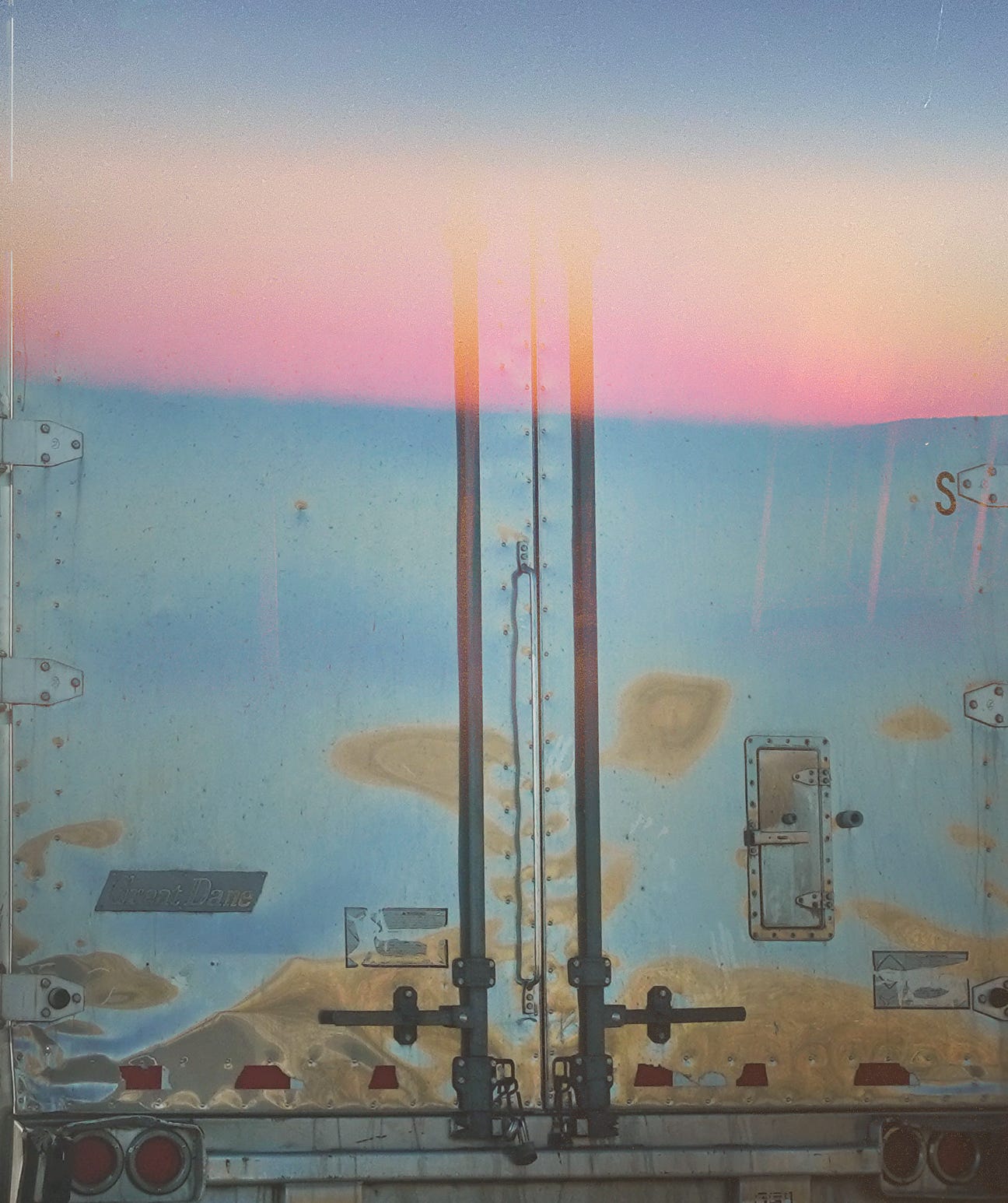
I remembered my first morning in Pasadena. I’d watched a small swarm of bees land on a photo of a wheat field enlarged across the side of an Orowheat truck. Churning inwards towards an unseen spiral core, the swarm, it seemed, had a gravity of its own. They undulated for hours across the pixelated image, scouring its surface for some hidden point of entry.
Near the pool’s edge, the host’s young children floated unattended on Kawaii pink PVC swans. Down below in the canyon, tiny cars speeding south hugged the curves, their headlights wobbling across the cliff face. The whisper of PCH congealed with the ocean into a single tonal unit. The pool filter began to gurgle. Black willow leaves gathered on the pool’s surface like dead pixels on a screen.
Oscar opened his phone and groaned, “Where are you going after this?”
holy shit what a pleasure to read thank you for this. you created a whole world here, reminds me of brett easton ellis but like written better and with better thoughts